
The HFC Phasedown Challenge: Refrigerant Availability
By Adam Kimmel
For years, conversations around refrigerant transitions have focused on cost. What will it cost to comply with the phasedown? What will refrigerant prices do next year? But for mobile A/C service, the most immediate challenge created by HFC (hydrofluorocarbon) phasedowns is actually availability.
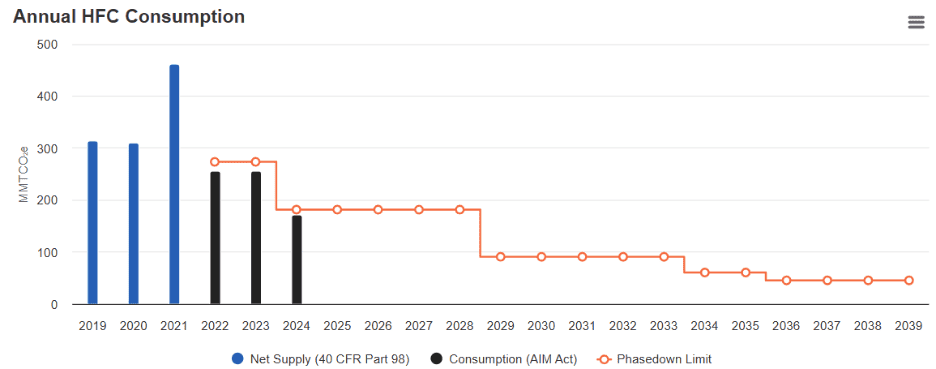
Under the AIM Act in the U.S. and similar global phasedowns from adoption of the Kigali Amendment to the Montreal Protocol, the total amount of HFCs that can be produced and sold each year is capped. Carbon equivalent allowances are being phased down to 15% of baseline by 2036, according to the schedule in Figure 1 below. In addition, an added constraint is that this schedule applies across all industries that use refrigerants, from automotive A/C to heat pumps and commercial chillers. Once producers hit their allowance, they are not permitted to continue supplying the market, regardless of demand.
For technicians and shop owners, this restraint changes the equation. As a result, the biggest challenge is not what R-134a costs. It’s whether you can readily get it at all.
Quotas Change How the Market Works
HFC phasedowns are based on CO₂-equivalent (CO2e) quotas. There are two types of quotas: consumption quota (how much can be sold) and production quota (how much a manufacturer can make). In simple terms, manufacturers are limited in how much refrigerant they can sell in total and how much they can produce at their plant. Even if a plant has capacity, it can’t exceed its production allowances, though they can be transferred. A company’s existing market share, typically the average of the highest years of production or import, sets its baseline, which is then subjected to the phasedown schedule. In the US, the EPA defines this as the average of the volumes produced and sold from 2011-2013.
R-134a remains widely used in vehicles on the road today, despite most new vehicle platforms moving to R-1234yf over the past few years. It is important to remember that the average age of vehicles currently in use in the United States is 12.6. Of course, existing R-134a vehicles don’t disappear just because the phasedown schedule moves forward. They still need to be serviced, recharged, and repaired. The challenge is that the supply available to meet that service demand is now fixed.
As refrigerant demand increases due to electrification, heat pumps, and other nonautomotive uses, mobile A/C is competing for a smaller share of the same quota pool of refrigerant. Competition is tightening the market. Supply and demand are at play.
Quota Calculated: Why Reducing GWP Is So Important
A common misconception is that the AIM Act is phasing down specific HFCs. In reality, the phasedown only limits the carbon intensity of a substance. Quotas are set in units of metric tonnes of CO2e. To calculate an HFC’s quota value, the mass of the HFC in metric tonnes is multiplied by the global warming potential (GWP). GWP is a multiplier that measures the ratio of how much heat a greenhouse gas traps in the atmosphere relative to CO2 over a set time, such as 20-year or [more commonly] 100-year timescales. So, the higher the GWP, the higher the carbon “cost” of continuing to use a higher GWP HFC. This is the factor that begins to constrain refrigerant availability.
An example of this could be for a quota value of 1000 MTCO2e, comparing R-134a (AR4 GWP 1430) with R-456A (AR4 GWP 687). For the same CO2e quota, reducing GWP from 1430 to 687 (a 52% reduction) allows more than twice the amount of R-456A and R-134a. This delivers substantial relief to HFC availability.


Availability Is the Primary Challenge for Mobile A/C
Price increases are hitting the market already, but they’re a response. The core issue is availability.
When producers fully utilize their HFC quota, as they are expected to do, any additional demand becomes unfulfilled. There isn’t a higher-priced option waiting in the wings. There’s simply no R-134a product to buy.
For mobile A/C service, that’s a real problem. Vehicles can’t wait months for the refrigerant supply to rebalance, as mobile A/C is a seasonal business. Fleet downtime, customer dissatisfaction, and lost service opportunities are real risks of product shortages.
Put simply, it’s impossible to service vehicles with refrigerant that simply isn’t available.
“The biggest challenge shops have is not what R-134a costs. It’s whether they can get it at all.”
Higher Prices Are the Effect, Not the Cause
R-134a pricing volatility and lift have been noticeable, and that will likely continue as quotas tighten further. But price alone doesn’t solve the issue of product availability.
Paying more doesn’t guarantee supply if the market is physically constrained. For shops, that means the risk isn’t just margin pressure; it’s the inability to complete vehicle A/C jobs and the potential outcome of turning down business, which can reduce shop profit margins.
Understanding that distinction is essential. For shop owners, the long-term challenge is managing supply risk, not just budgeting for higher costs.
Why Switching Everything to R-1234yf is not Practical
One response to the tightening supply of R-134a, a non-flammable refrigerant, is to accelerate the move to an A2L, R-1234yf. For new vehicles designed around YF, that makes sense. For the existing fleet, it’s not always realistic.
R-1234yf systems are fundamentally different from R‑134a systems. They involve:
- A different safety classification (A2L)
- Different components, rubber/elastomers, and lubricants
- Changes in service procedures, tools, and training
Many vehicles on the road today were never engineered for YF. Converting them can be costly, complex, and impractical, especially for older vehicles or large fleets where the owners are motivated to reduce the end-of-life total cost of ownership (TCO).
For those systems, the issue isn’t preference; it’s feasibility.
R-456A: A Practical Option for R-134a Systems
The solution to availability and continued service for R-134a vehicles is on the market now. As R-134a supply tightens, R‑456A offers a different path forward for mobile A/C service.
R-456A, a nonflammable (A1) composite refrigerant designed specifically for use in existing R-134a systems, has emerged to bridge this gap in R-134a availability. Rather than forcing a system redesign, this refrigerant allows shops to maintain familiar equipment and service practices.
For shops providing A/C service, a switch to R-456A offers some real advantages:
- Comparable performance to R-134a
- No need to transition to A2L system designs
- Continued serviceability of the existing vehicle fleet
These advantages are why over 1 million vehicles in the EU have already switched to R-456A.
From a supply standpoint, R-456A is a composite refrigerant composed of R-1234ze(E) (49 mass%), R-134a (45%), and R-32 (6%). With only 45% R-134a in R456A’s composition, this relieves pressure on constrained R-134a quotas by shifting demand away from virgin R-134a where appropriate.
It’s not about replacing every refrigerant with a single solution. It’s about having practical options that extend the useful lives of R-134a vehicles, keeping them on the road for shops to service.
Graphic: R-134a System Pathways
| Existing R‑134a System | Convert to R-1234yf | Use R-456A |
|---|---|---|
| Safety classification | ❌ Switch from A1 to A2L | ✅ Remains A1 (non‑flammable) |
| Components & hardware | ❌ Significant changes required | ✅ Minimal to no changes |
| Service practices | ❌ New procedures & training | ✅ Familiar service approach |
| Practical for legacy fleet | ❌ Requires changes to older vehicles | ✅ Extends useful life of fleet |
| Impact on R‑134a supply | ✅ Reduces demand | ✅ Reduces demand |
What This Means for Shops and Technicians
Solutions that preserve existing system designs while addressing supply constraints will play an important role during this transition period. For many R-134a systems, R-456A provides a way to keep servicing vehicles without unnecessary complexity. It also allows long-lifecycle vehicles like Class 8 trucks to maintain much longer lifecycles.
The goal for shops isn’t to add refrigerants for differentiation alone. It’s to service a higher percentage of the market in response to a constantly changing regulatory environment.
About the Author

Adam Kimmel is an R&D and business development leader with over 20 years of experience in process design, product marketing, research, and new product development in chemical and mechanical engineering. He leverages his experience as an engineering SME to work with customers to implement the best thermal management solution for their applications.
About MACS
MACS is the Mobile Air Climate Systems Association. We are the non-profit trade association representing manufacturers, distributors, service shops, technicians and educators in the mobile air conditioning and vehicle thermal management sectors.
Are you a MACS member? Join MACS today! Learn more about our association.
MACS is the largest provider of US EPA Section 609 Certification for technicians working on vehicle air conditioning, refrigerant and climate control systems. Get your MACS 609 Certification today on our website.
Have a comment about this article? We want to hear from you! info@macsmobileairclimate.org
Want to learn more about what’s happening in the mobile air conditioning industry? Be sure to read the next issue of ACtion Magazine! The mobile air conditioning industry’s journal of record. Published by MACS, you can find ACtion on our website.
Thanks For Reading!
Published on 13-MAY-2026.
Leave a Reply